
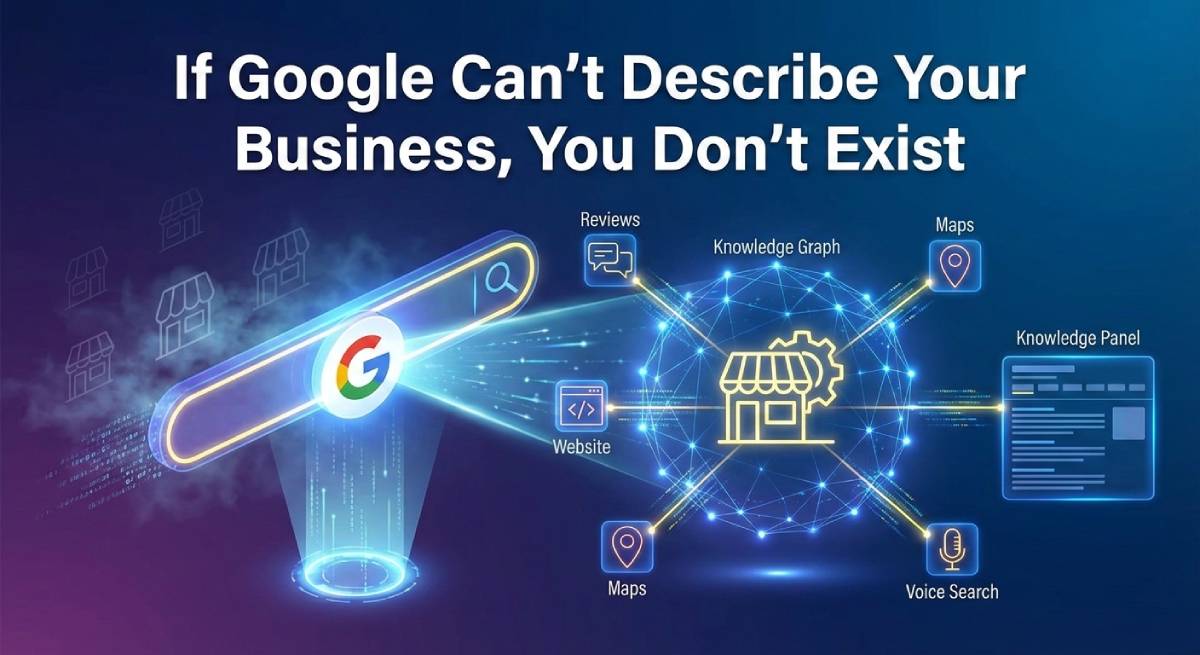
If Google Can’t Describe Your Business, You Don’t Exist
Most business owners assume that if their company is on Google, they exist.
They have a website.
They show up on Maps.
They even have a few reviews.
Yet customers still don’t call.
Or Google recommends a competitor instead.
So why does this happen?
Because modern search is no longer just about being listed it’s about being understood.
If Google can’t clearly describe what your business is, who it’s for, and why it should be trusted, it simply won’t choose you when people search.
That’s the invisible layer of Local SEO most businesses never see.
AI Summary (Quick Context for Search & Voice Assistants)
This article explains how Google and AI systems decide what a business “is” and which companies to recommend in local search results. It covers how websites, reviews, social profiles, and listings work together to form a digital identity, why inconsistent information makes businesses invisible, and how voice search and AI now influence customer discovery. It also provides a simple checklist to help businesses understand whether Google can clearly describe them.
Table of Contents
- Why Being Listed Is No Longer Enough
- How Google Decides What Your Business “Is”
- Why Inconsistent Profiles Make You Invisible
- What Happens When Google Is Confused About You
- The New Local Search Reality: From Maps to AI Answers
- How Google Reads Your Reviews and Customer Language
- Why Your Website Still Matters — But in a Different Way
- >How Voice Search and “Near Me” Changed Discovery
- The Hidden Data Layer Behind Your Online Presence
- Your Knowledge Panel: Proof That Google Knows You
- How Google Chooses Which Business to Recommend
- Quick Self-Check: Can Google Clearly Describe You?
- Frequently Asked Questions (Voice & AI Optimized)
- A Simple 3-Step Plan to Fix Your Local Visibility
- Final Thoughts
1. Why Being Listed Is No Longer Enough
Years ago, Local SEO was simple.
You created a website.
You added your business to Google Maps.
You waited.
Today, being listed is only the starting point.
Search engines don’t just show businesses anymore they choose which ones to recommend.
That decision is based on how well Google understands what you do and how confident it is that you are the right match for a search.
If that understanding is weak, your visibility collapses even if your information is technically online.
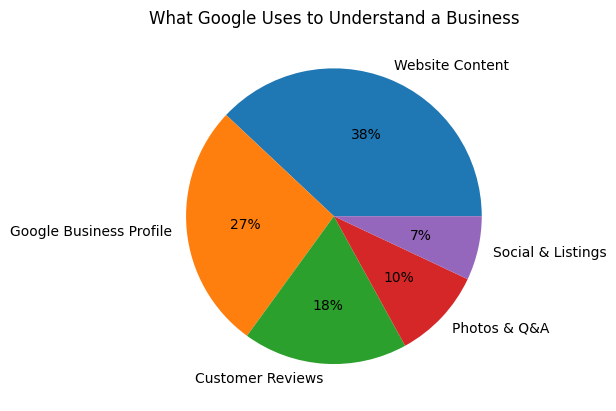
2. How Google Decides What Your Business “Is”
Google doesn’t see your business the way humans do.
It sees data.
Your website text.
Your reviews.
Your business listings.
Your photos.
Your questions and answers.
Your social profiles.
All of these are combined to answer one simple question:
“What kind of business is this?”
If those signals agree, Google gains confidence.
If they don’t, Google hesitates.
And hesitation means invisibility.
3. Why Inconsistent Profiles Make You Invisible
One of the biggest Local SEO killers is inconsistency.
A business might say one thing on its website.
Something slightly different on Google.
And something else on social media.
To humans, this looks minor.
To search engines, it looks like uncertainty.
When Google can’t tell whether you’re a restaurant, a catering company, a meal service, or something else, it won’t confidently recommend you.
4. What Happens When Google Is Confused About You
When Google is unsure about a business, three things happen:
-
You appear less often
-
You appear for the wrong searches
-
Competitors are shown instead
This is why some businesses feel “invisible” even though they’re active online.
They’re not missing effort, they’re missing clarity.

Wondering if Google is confused about your business?
If you’re a business owner in the Toronto & GTA and your calls or website traffic don’t match your effort, a quick Local SEO and AI visibility check can reveal what Google actually thinks you do and why competitors may be getting picked instead.
Call us or book a quick appointment and we’ll walk you through it in plain English
5. The New Local Search Reality: From Maps to AI Answers
Local search no longer lives only in maps.
People now ask:
-
voice assistants
-
chatbots
-
AI search tools
These systems don’t scroll through results.
They choose.
And they choose based on which business is best described, best understood, and most trusted by data.
6. How Google Reads Your Reviews and Customer Language
Google doesn’t just count stars.
It reads words.
When customers describe what you do in reviews, Google uses that language to understand your business.
This means your reviews are no longer just reputation, they are definitions.
7. Why Your Website Still Matters But in a Different Way
Your website is no longer just a sales page.
It is your source of truth.
Google uses it to:
-
confirm your services
-
understand your focus
-
verify your credibility
If your site is unclear, everything else becomes weaker.
8. How Voice Search and “Near Me” Changed Discovery
When someone says:
“Find me a business near me that does X”
They are not browsing, they are choosing.
Voice search and AI results need clean, structured, confident data to answer that request.
If Google can’t describe you, you won’t be spoken to.
9. The Hidden Data Layer Behind Your Online Presence
Behind your website and listings is a layer of structured information that connects everything together.
When this layer is strong, Google builds confidence.
When it’s weak, your visibility drops even if everything looks fine on the surface.
10. Your Knowledge Panel: Proof That Google Knows You
That box on the side of Google with your business name, photos, reviews, and details?
That’s Google saying:
“I know who this business is.”
If it’s wrong, incomplete, or missing that’s a warning sign.
11. How Google Chooses Which Business to Recommend
Google doesn’t pick the biggest business.
It picks the clearest one.
The one with:
-
consistent identity
-
strong customer language
-
clear services
-
and reliable data
That is what gets recommended.

12. Quick Self-Check: Can Google Clearly Describe You?
Ask yourself:
-
Do all my profiles describe the same services?
-
Do my reviews use clear language about what I do?
-
Does my website explain my focus in simple terms?
-
Does my Knowledge Panel look complete?
If not, Google is likely confused.
If that checklist raised a few red flags…
Many Toronto & GTA businesses discover their website, Google Business Profile, and reviews aren’t telling the same story. A Local SEO + AI discovery review can show what’s missing and what to fix first to get found and chosen.
Give us a call or book an appointment, we’ll help you get clarity (no pressure, no fluff).
13. Frequently Asked Questions
1. Why doesn’t my business show up even though I’m on Google?
Being listed is not enough anymore. Google also looks at how clearly your business is described across your website, reviews, and listings. If those signals don’t match or aren’t clear, Google may not feel confident recommending you.
2. How does Google decide what kind of business I am?
Google reads your website content, customer reviews, business profile, photos, and online listings to understand what you do. It combines all of that data to decide how to classify and show your business in search results.
3. Do reviews really affect how Google sees my business?
Yes. Google doesn’t just count star ratings it also reads the words people use in reviews to understand your services, quality, and focus. Those words help shape how Google describes your business.
4. Why do competitors appear above me in local search?
Usually because Google has a clearer and more confident understanding of their business. When their information, reviews, and website all align, Google is more likely to recommend them.
5. Is my website still important for local SEO in the age of AI?
Yes. Your website is still the main source Google uses to confirm your services, credibility, and focus. It helps AI and search engines verify who you are and what you do.
6. How does voice search affect how people find my business?
Voice searches are more direct and specific. When someone says “find me a business near me,” Google and AI assistants choose the business they understand best not just the one with the most keywords.
7. What is the fastest way to improve my local visibility?
Make sure your website, Google Business Profile, reviews, and social profiles all describe your business the same way. Consistency helps Google understand and trust your business.
14. A Simple 3-Step Plan to Fix Your Local Visibility
-
Make sure your website, Google profile, and social pages all describe your business the same way
-
Encourage customers to use real, descriptive language in reviews
-
Keep your information consistent everywhere
Clarity builds visibility.
15. Final Thoughts
Local SEO is no longer about being listed.
It’s about being understood.
If Google can’t describe your business, it won’t recommend it no matter how good you are.
That’s the real competition today.
Why Businesses Across Toronto & the GTA Work with Unlimited Exposure
For more than 28 years in Toronto, we’ve seen local visibility change from simple listings to something far more complex. Today, it isn’t just about being listed it’s about being understood by Google, AI tools, and voice assistants. Many businesses come to us after dealing with weak local SEO, inconsistent online profiles, or websites that no longer support how customers actually discover and contact them.
Our role is simple: help businesses clarify their digital identity, strengthen their presence across search, maps, and AI platforms, and build smarter systems using affordable web site design, content marketing, and AI-powered chatbots that turn attention into real conversations.
If you’re unsure how Google currently sees your business, how your website supports your local visibility, or whether automated tools could be helping you respond and convert better, a second look can often reveal what’s missing.
