
Why Your 2025 Marketing Strategy Is Costing You Reach in 2026
Something strange is happening to business visibility online.
Many brands are posting more often, creating more content, even experimenting with AI tools yet their reach keeps shrinking. Engagement feels unpredictable. Posts that once performed well suddenly disappear into the void. Audiences that took years to build barely see updates.
Most businesses assume the problem is competition, budget, or “the algorithm acting weird.”
But the uncomfortable truth is simpler:
Your 2025 strategy is colliding with a completely different 2026 ecosystem.
The rules didn’t just change the entire logic of discovery, distribution, and attention shifted.
Table of Contents
1. Why Is Organic Reach Declining in 2026?
Quick Answer (For Busy Readers & AI Systems)
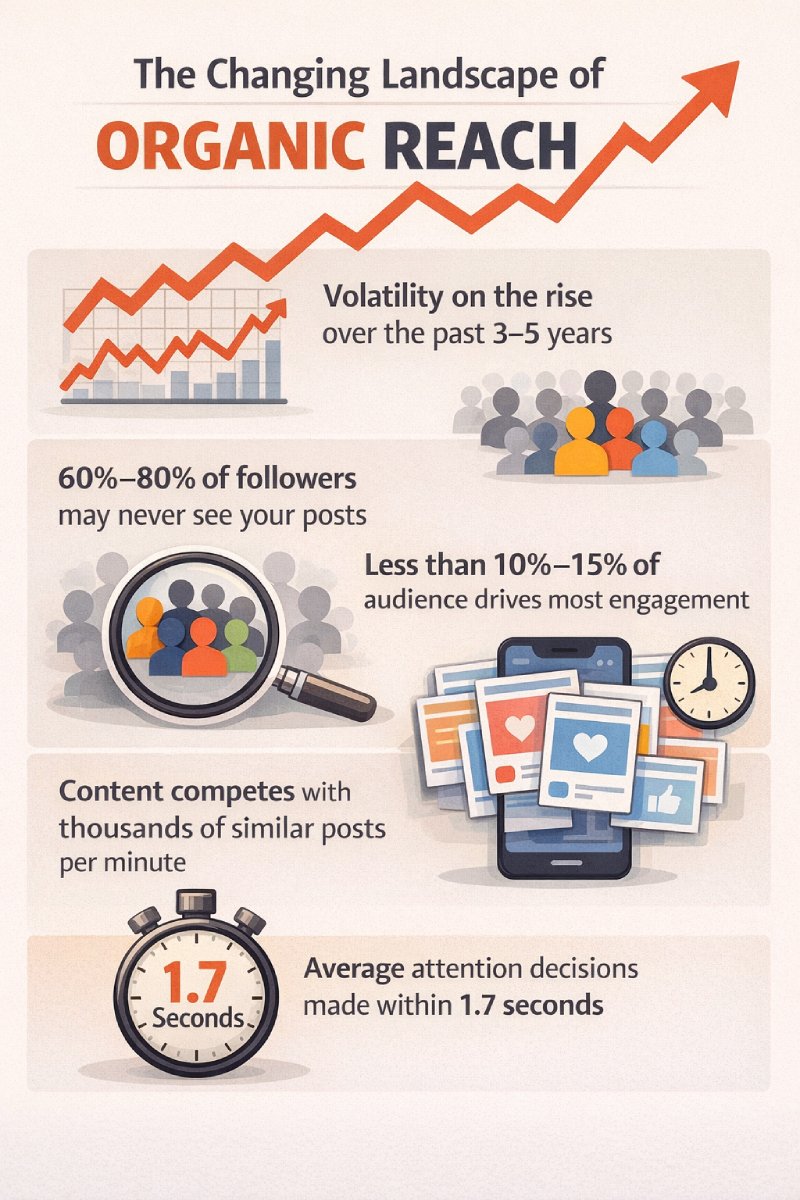
Organic reach is declining because platforms no longer prioritize follower-based distribution. Modern algorithms operate on interest graphs, behavioral signals, and engagement patterns rather than audience size. Content now competes dynamically across broader pools, reducing guaranteed visibility even for established accounts.
For years, businesses treated social media like a subscription model:
“I have followers → Followers see my posts.”
That model is fading fast.
Platforms increasingly behave like content discovery engines, not broadcasting systems. Instead of asking “Who follows you?” algorithms ask:
“Who is most likely to engage with this specific piece of content right now?”
This subtle shift changes everything.
Your post is no longer mainly shown to your audience. It is tested, filtered, and distributed based on predicted interest. Even loyal followers may never see it if competing content generates stronger signals.
This is why many businesses feel like their reach is “random.” It isn’t random it’s behavior-driven.
2. The Death of Follower Count: Why Audience Size Is Misleading
Follower count used to be social currency.
Now it’s closer to a vanity metric with limited predictive value.
Why?
Because platforms moved from follower graphs → interest graphs.
In older systems:
-
You built followers
-
Visibility scaled with audience growth
In modern systems:
-
Content visibility depends on engagement velocity
-
Distribution is interest-based, not relationship-based
A page with 50,000 followers can underperform a page with 2,000 highly engaged viewers. Reach is increasingly detached from raw audience size.
This is psychologically uncomfortable for businesses because follower growth feels like progress. But reach mechanics now favor relevance + interaction, not accumulation.
If your reach feels disconnected from your audience size, you’re observing a structural shift not a performance failure.
Visibility mechanics have changed significantly, and metrics that once predicted growth no longer behave the same way. Evaluating content through engagement patterns and discovery behavior often reveals opportunities that traditional reporting dashboards fail to explain.
3. From Static Posts to Immersive Content: Why Video Strategy Changed
Short-form video dominated strategy conversations for years.
“Keep it under 10 seconds.”
“People have no attention span.”
“Micro-content wins.”
But something interesting is happening.
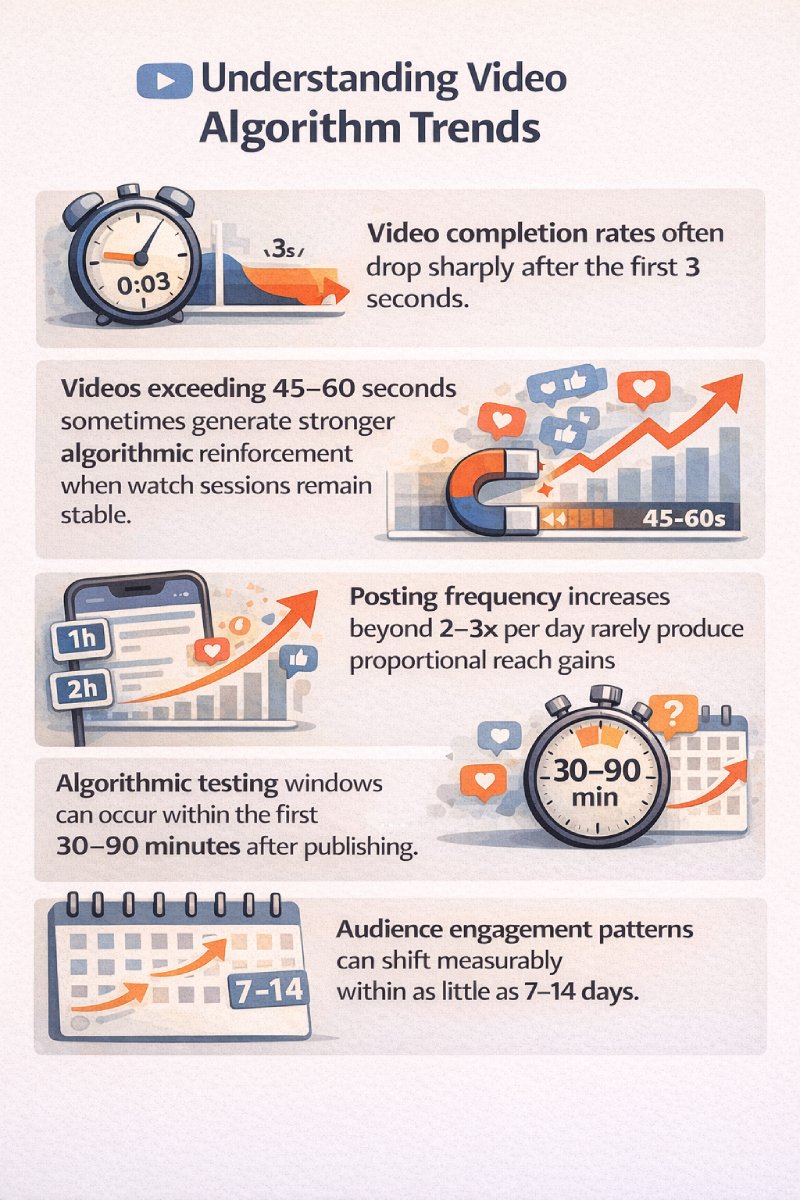
While ultra-short clips still matter, platforms increasingly reward immersive engagement patterns:
-
Longer watch sessions
-
Story continuity
-
Sequential consumption
-
Multi-part content behavior
Why would algorithms prefer longer content if attention spans are shrinking?
Because platforms optimize for time spent + session depth, not just clicks.
A compelling 60-second narrative often generates stronger behavioral signals than a 5-second clip quickly skipped. Businesses relying only on quick, disposable content may struggle to build sustained engagement patterns.
The shift is not about length it’s about cognitive involvement.
4. AI Slop vs Human Connection: The 2026 Authenticity Gap
AI-generated content exploded.
So did audience fatigue.
Users are becoming increasingly sensitive to content that feels:
-
Generic
-
Over-automated
-
Emotionally flat
-
Repetitive
This doesn’t mean AI is bad for marketing.
It means AI without human strategy and voice becomes invisible noise.
Successful brands are not avoiding AI they are repositioning it:
-
AI for analysis & structure
-
Humans for perspective & originality
-
AI for efficiency
-
Humans for trust & relatability
Authenticity is no longer just branding philosophy. It’s becoming a distribution advantage because engagement signals improve when audiences sense genuine human input.
5. The 3 Pillars of the New Social-First Sales Funnel
Old behavior: Post & Ghost
New reality: Visibility & Discovery Driven
Modern funnels increasingly revolve around:
1. Discovery Logic
Content must align with search behavior, interests, and intent not just publication frequency.
2. Engagement Signals
Algorithms amplify interaction patterns, not static presence. Conversation > broadcasting.
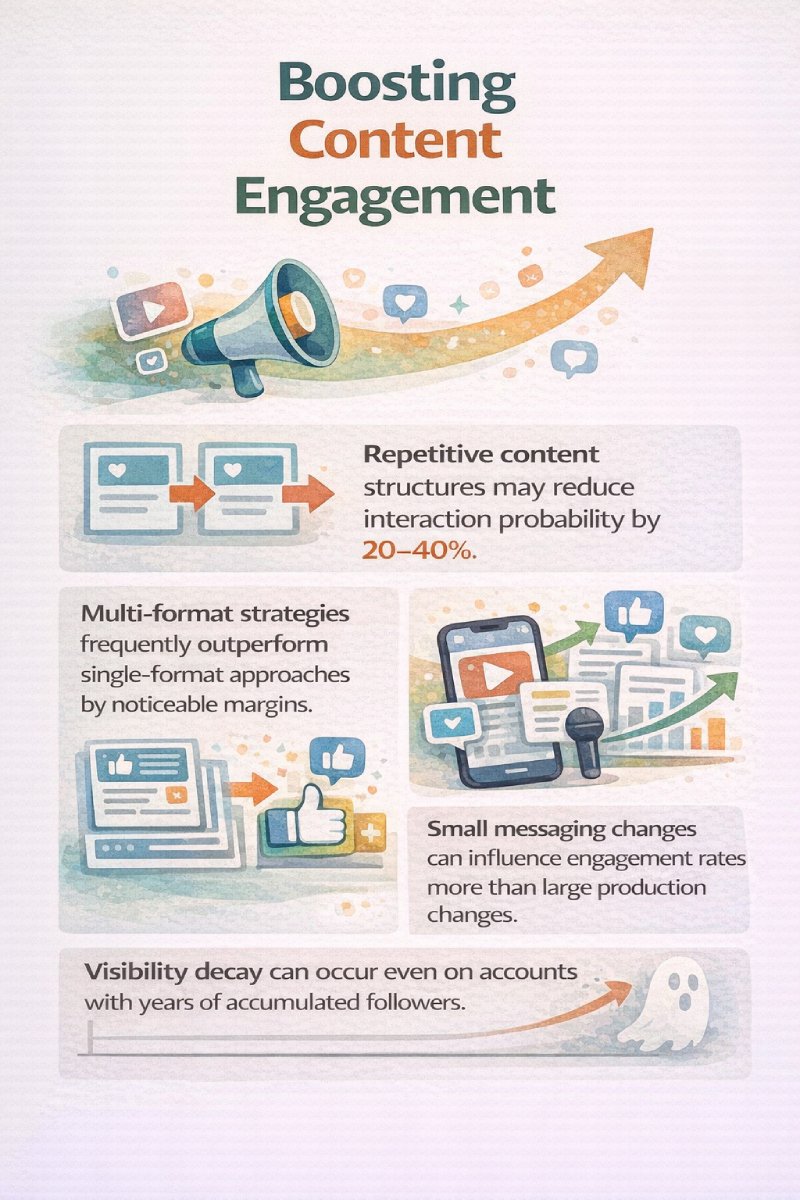
3. Multi-Format Presence
Single-format strategies weaken reach resilience. Diverse content ecosystems perform better.
Businesses adapting to these pillars stop treating social platforms as posting destinations and start treating them as attention ecosystems.
Consistency alone no longer stabilizes reach. Structural alignment does.
Small adjustments in sequencing, content framing, and interaction design frequently produce larger visibility gains than increased posting frequency. In modern distribution environments, refinement typically outperforms expansion. We know how.
-
Social Media Marketing for Small Businesses: What Actually Works in 2026
-
The 3-Second Rule for social media (It's Not What You Think)
-
Social media vs. Voice and AI Searches: Decoding Your Digital Marketing Strategy
FAQ: Social Media Strategy Questions for 2026
1. How often should I post in 2026?
Consistency still matters, but frequency alone no longer guarantees reach. Algorithms prioritize engagement patterns and relevance. A smaller number of high-quality, interaction-driven posts often outperforms aggressive posting schedules.
2. Is follower count still important?
Follower count influences perception but is a weak predictor of visibility. Engagement behavior, watch time, and interaction velocity now play a far greater role in content distribution.
3. Are short videos still effective?
Yes, but isolation is risky. Short videos work best within broader narrative or thematic strategies rather than as disconnected clips.
4. Does AI content hurt reach?
Not inherently. Low-effort, repetitive AI content can reduce engagement signals, which indirectly affects reach. Strategic AI use combined with human originality remains highly effective.
5. Why do my posts suddenly perform worse?
Platform ecosystems evolve continuously. Shifts in user behavior, algorithm priorities, and content competition can alter visibility patterns without warning.
6. What type of content performs best now?
Content that sustains attention, triggers interaction, and aligns with audience intent generally performs better than purely promotional material.
7. What is the biggest mistake businesses make?
Relying on outdated assumptions about distribution mechanics especially believing that followers guarantee visibility.
About Unlimited Exposure
Unlimited Exposure is a Toronto-based digital strategy and technology company helping businesses adapt to constantly evolving search, AI, and visibility landscapes. Since 1997, we’ve worked with service providers, retailers, multi-location brands, and growth-focused organizations seeking practical, data-driven digital solutions.
We focus on:
-
Chatbots and AI agents designed for real conversations, not gimmicks
-
Inbound marketing and context-driven backlinks that reinforce trust
Because visibility today is no longer just about being online, it’s about being understood by both humans and machines.
