
Why E-Commerce Solutions Fail After 12 Months (And No One Talks About It)
Let’s say this clearly.
Most e-commerce solutions don’t fail at launch.
They fail quietly… about a year later.
Not with drama.
Not with a crash.
Just slow leaks.
Conversions dip.
Ad costs rise.
Customers hesitate longer.
Margins tighten.
And suddenly you're wondering:
“Did we choose the wrong platform?”
Maybe.
But probably not for the reason you think.
This isn’t about Shopify vs WooCommerce vs custom builds.
This is about what happens after the honeymoon phase ends.
And almost nobody talks about that part.
Table of Contents
Key Takeaways
- E-commerce stores rarely fail at launch - they stall from stagnation.
- Traffic does not fix conversion problems.
- Tech debt accumulates quietly and slows performance.
- Retention systems matter more than flashy design.
- Optimization is not optional - it’s ongoing.
The 90-Day High
When a new store launches, everything feels electric.
New branding.
New theme.
Ads firing.
Sales rolling in.
Momentum creates confidence.
But launch energy hides structural weaknesses.
In the first few months:
• Friends and early supporters purchase
• Paid ads are aggressively optimized
• Discounts drive urgency
• Curiosity boosts conversions
It works.
Until novelty fades.
The early spike is not proof of long-term stability. Its momentum fueled by excitement and aggressive acquisition.
The 12-Month Reality Check
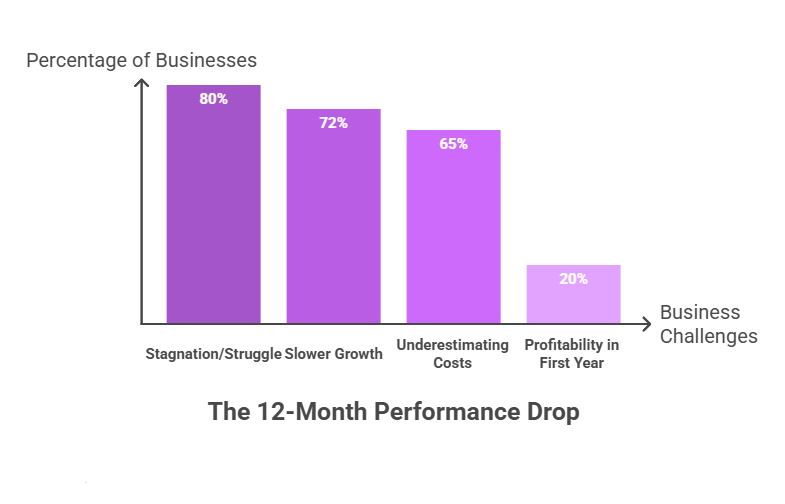
Around months 8 to 12, something shifts.
Ad costs climb.
Conversion rates flatten.
Repeat purchases slow.
Customer acquisition becomes expensive.
Suddenly the math changes.
You start tweaking headlines.
Testing new creatives.
Blaming the platform.
Switching agencies.
But the issue is rarely surface-level.
It’s systemic.
The 5 Real Reasons E-Commerce Solutions Fail
Let’s break this down honestly.
1. The Traffic Trap
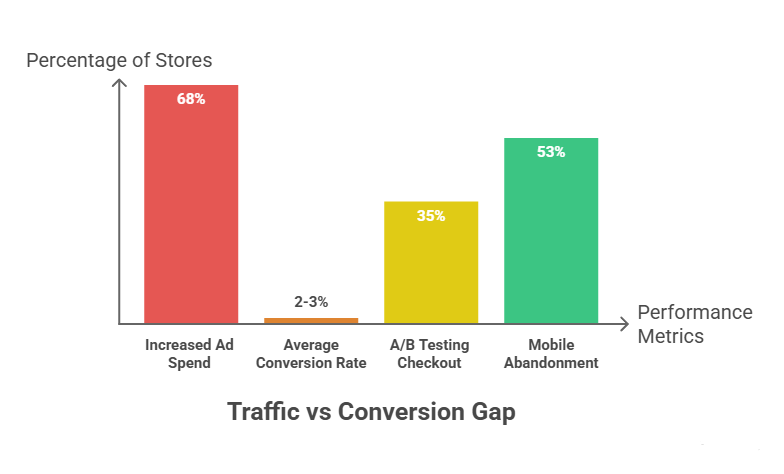
More traffic is not a growth strategy.
It’s an amplifier.
If your checkout has friction,
If your product positioning is unclear,
If your mobile experience feels clunky,
If your offer lacks urgency,
More traffic simply means more people leaving.
Traffic multiplies whatever already exists.
Many e-commerce stores are built to look impressive, not convert sustainably.
Pretty isn’t profitable.
2. Conversion Drift
Conversion drift is subtle.
What worked six months ago slowly loses effectiveness.
Why?
-
Consumer behavior evolves
-
Competitors improve
-
Algorithms shift
-
Expectations rise
But many stores stay frozen in launch mode.
No A/B testing.
No checkout refinement.
No UX evolution.
The decline is gradual.
No alarm goes off.
Revenue just feels heavier to generate.
3. Tech Debt Accumulates Quietly
At launch, everything feels clean.
Then the apps start stacking.
Email automation.
Upsells.
Analytics layers.
Payment integrations.
Shipping tools.
Loyalty systems.
Each tool solves a small problem.
But over time:
-
Page speed slows
-
Tracking conflicts emerge
-
Updates break functionality
-
Checkout complexity increases
Now your “solution” becomes a patchwork system.
And patchwork systems do not scale gracefully.
Simplicity scales. Complexity leaks.
4. No Backend Revenue Strategy
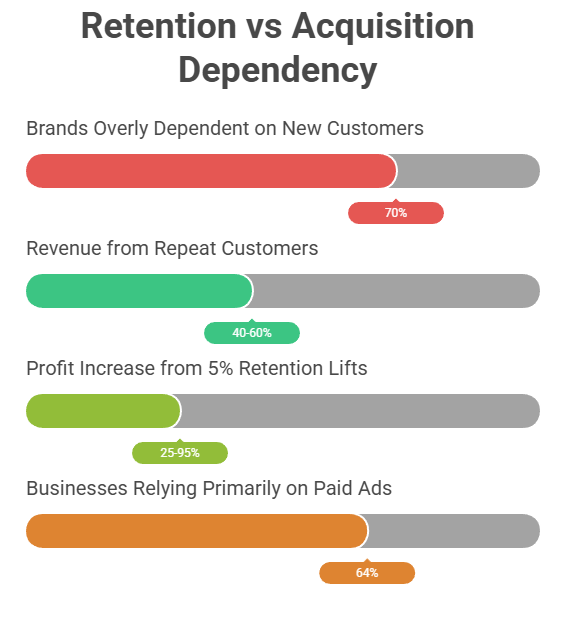
Most e-commerce businesses obsess over acquisition.
Very few obsess over retention.
After month six, your store should be supported by:
-
Automated email flows
-
SMS reactivation
-
post-purchase upsells
-
Bundling strategies
-
Subscription models
-
Loyalty programs
If you constantly need new customers to survive, your business becomes fragile.
Acquisition costs rise over time.
Retention lowers risk.
The healthiest stores earn repeatedly from the same customers.
5. The “Set It and Forget It” Illusion
Here’s the uncomfortable truth.
Some founders treat an e-commerce store like a vending machine.
Build it.
Turn it on.
Collect revenue.
That’s not how digital commerce works.
An e-commerce solution is a living system.
It requires:
-
Iteration
-
Testing
-
Data analysis
-
UX refinement
-
Pricing adjustments
-
Funnel improvements
If you treat it like a static website, it performs like one.
Flat.
The Hidden Issue: Misaligned Expectations
Many frustrations are not technical.
They’re psychological.
People expect:
-
Immediate scale
-
Stable ad returns
-
Predictable growth
-
Viral traction
But online markets are competitive.
Margins tighten.
Attention spans shrink.
Customers compare faster.
Without continuous optimization, your store becomes average.
And average rarely wins online.
What Sustainable E-Commerce Actually Looks Like
Let’s flip the conversation.
What does a healthy e-commerce solution look like after 12 months?
1. Built for Adaptability
Not overloaded with apps.
Not dependent on one traffic source.
Not fragile.
Flexible.
2. Data-Driven Decisions
You track:
-
Conversion rates
-
Heatmaps
-
Checkout drop-offs
-
Cart abandonment
-
Repeat purchase rate
You don’t guess.
You measure.
3. Mobile-First Experience
In most industries, over 60% of traffic is mobile.
If your mobile UX feels slow or confusing, you’re leaking revenue daily.
Small friction on mobile equals large losses at scale.
4. Revenue Diversification
Not just paid ads.
Also:
-
Organic search
-
Email marketing
-
Repeat customers
-
Partnerships
-
Content marketing
Diversification protects stability.
5. Ongoing Conversion Optimization
Not constant redesigns.
Refinement.
Small improvements stacked over time create compound growth.
Improving checkout by 5%.
Increasing repeat purchases by 7%.
Reducing load time by 1 second.
These incremental gains matter more than flashy relaunches.
-
How to Get Alexa, Siri, and Google Assistant to Recommend Your Business
-
Before You Hire a Web Developer What Business Owners Need to Understand (But Rarely Do)
-
If Your Website Looks Like This in 2026, You’re Already Losing Customers
The Question Most Founders Avoid
Instead of asking:
“Which platform is best?”
Ask:
“Do we have a long-term revenue system, or just a strong launch event?”
Those are two very different things.
One compound.
One fades.
If your e-commerce store feels heavier at month 12 than it did at launch, it may not need a rebuild- it may need recalibration. Let’s evaluate your conversion systems, retention structure, and long-term scalability before you invest more into traffic.
Talk to our team about building sustainable E-commerce Solutions that grow beyond launch momentum.
Final Thoughts
Most e-commerce solutions do not fail because they were built incorrectly.
They fail because they stop evolving.
Digital commerce is dynamic.
Your systems must be too.
If you’re at month 12 and things feel heavier than they did at launch, you’re not alone.
You’re not broken.
You’re just at the stage most people don’t prepare for.
Frequently Asked Questions
1. Why do e-commerce solutions fail after 12 months?
Most e-commerce solutions fail after 12 months because they are optimized for launch, not long-term performance. Traffic costs increase, conversion rates decline, tech complexity grows, and retention systems are often weak. Without ongoing optimization, growth slows gradually.
2. Is it the platform’s fault when growth stops?
Rarely. Platform limitations can matter, but most performance issues stem from strategy gaps, poor retention systems, or lack of testing. The slowdown is usually operational, not technical.
3. What are signs my store is plateauing?
Rising ad costs, lower conversion rates, stagnant revenue despite increased traffic, and declining repeat purchases are common indicators. If growth feels harder than it did at launch, recalibration is needed.
4. What is conversion drift?
Conversion drift is the gradual decline in performance as customer behavior, competition, and expectations evolve. Without ongoing testing and UX updates, what once worked becomes less effective.
5. Do I need to rebuild my store after a year?
Usually not. Most stores need optimization, not reconstruction. Improving checkout flow, simplifying tech stack, strengthening backend marketing, and enhancing mobile UX often deliver better results than rebuilding.
6. How important is retention?
Retention is critical. Sustainable e-commerce businesses generate significant revenue from repeat customers through email flows, loyalty programs, subscriptions, and upsells. Acquisition alone is unstable and expensive.
7. What makes an e-commerce solution sustainable long term?
Long-term sustainability requires data tracking, continuous conversion testing, streamlined technology, diversified revenue channels, and strong backend marketing systems. It must evolve instead of remaining frozen in launch mode.
Unlimited Exposure is a Toronto-based digital marketing and web development company focused on measurable business growth.
If you’ve ever searched “digital marketing agency near me” or “web development company near me,” you already know how difficult it is to find a team that prioritizes real leads, conversions, and revenue instead of vanity metrics and polished reports.
Since 1997, we’ve helped businesses across Toronto and the GTA build practical, performance-driven systems that increase visibility, improve conversion rates, and strengthen long-term customer acquisition. That includes developing scalable E-commerce Solutions designed not just to launch beautifully, but to evolve, optimize, and grow sustainably over time.
Because traffic alone isn’t a strategy.
A revenue system is.
