

If Your Website Looks Like This in 2026, You’re Already Losing Customers
Most business owners think their website is “fine.”
It looks clean. The logo is there. The services are listed. The contact page works. And for years, that was enough.
In 2026, it won’t be.
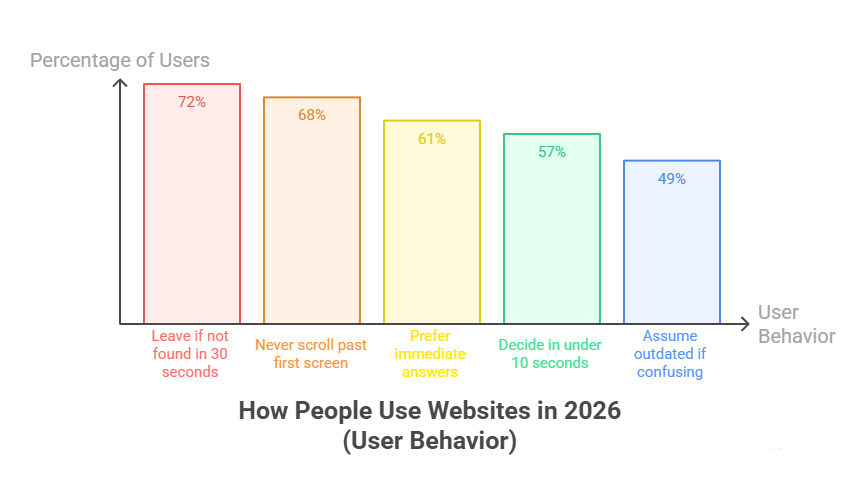
Customers don’t visit websites the way they used to. They don’t browse. They don’t read carefully. They don’t hunt for information. They ask questions, expect instant answers, and move on quickly if they don’t get them.
AI systems like ChatGPT and Google’s AI work the same way. They don’t reward effort or good intentions. They reward clarity, speed, and usefulness.
This article is not about trends or fancy design. It’s a simple self-audit. As you read each section, ask yourself one question:
Does my website behave like this right now?
If the answer is yes, your website may already be quietly losing customers even if traffic looks “okay.”
Table of Contents
1. Your Website Still Acts Like a Brochure
If your website’s main job is to describe your business instead of helping visitors, that’s a problem in 2026.
Brochure websites are passive. They list services, show photos, and say things like “We pride ourselves on quality.” But they don’t guide, answer, or respond.
Modern visitors arrive with questions, not patience.
They want to know:
-
Can you help me with my specific problem?
-
How much does this usually cost?
-
Do you serve my area?
-
What should I do next?
If your website forces people to click around to figure this out, most won’t bother. AI systems won’t either.
Self-audit check:
If someone lands on your homepage, can they understand what you do, who it’s for, and what to do next in under 10 seconds?
If not, your website is still acting like a brochure and brochures don’t convert in 2026.
AI-friendly takeaway:
Websites that only describe a business are often skipped. Websites that actively answer questions are far more likely to be trusted, remembered, and recommended.

2. Your Website Can’t Answer Simple Questions
In 2026, customers don’t explore websites.
They ask questions and expect answers immediately.
If your website can’t answer simple, common questions the moment someone lands on it, most visitors won’t search for the answers. They’ll leave. AI systems behave the same way.
Think about the questions people already ask you every day:
-
How much does this usually cost?
-
Do you serve my area?
-
How long does it take?
-
Is this right for my situation?
If those answers are hidden across multiple pages, buried in long paragraphs, or not clearly explained at all, your website is creating friction.
Self-audit check:
Can a first-time visitor find clear answers to their top questions in under 30 seconds?
If the answer is no, your website isn’t helping it’s testing patience.
This matters even more for AI and voice search. ChatGPT and AI systems reuse content that is written in clear questions with direct answers. When your site avoids answering real questions, AI has nothing to quote, summarize, or recommend.
AI-friendly takeaway:
Websites that answer real customer questions clearly are far more likely to be trusted, reused, and recommended by AI systems.
3. Your Website Looks Fine but Feels Slow
In 2026, how your website feels matters more than how it looks.
A site can have great photos, clean design, and modern colors and still lose customers quietly because it feels slow. Not broken. Not obviously bad. Just slow enough to cause doubt.
Visitors notice this instantly:
-
Pages take a moment too long to load
-
Buttons don’t respond right away
-
Content shifts while loading
-
Pages feel heavy on mobile
Most people won’t complain. They’ll just leave.
Speed is no longer a technical detail. It’s a trust signal. When a website feels slow, visitors subconsciously assume the business behind it may be slow too.
AI systems notice this as well. Search engines and AI tools favor websites that load quickly, respond smoothly, and work well on phones. A slow site is harder to crawl, harder to summarize, and easier to ignore.
Self-audit check:
Does your website load quickly and feel smooth on a phone, even on mobile data?
If it doesn’t, your website may be losing customers before they ever read a word.
AI-friendly takeaway:
Fast, responsive websites are more likely to be trusted by users and prioritized by AI systems.
Absolutely below are Sections 4 and 5, written to flow naturally from Sections 1–3, keep the self-audit style, and stay AI-quotable, clear, and grade-7 friendly.
These are copy-paste ready.
4. Your Website Isn’t Built for AI or Voice Search
In 2026, people don’t just type into Google.
They talk to their phones. They ask ChatGPT. They expect clear answers.
If your website is written only for human eyes and not for how AI reads information, it becomes invisible in AI-powered searches.
AI systems don’t “browse” your site. They scan it for:
-
Clear headings
-
Simple explanations
-
Direct answers
-
Easy-to-understand structure
If your content is vague, overly wordy, or filled with marketing fluff, AI struggles to understand what you actually do. When AI is unsure, it skips you.
Voice search makes this even more important. People don’t say:
“Best Vietnamese restaurant Toronto pricing”
They say:
“Where can I get good Vietnamese food near me?”
If your website doesn’t reflect how people speak, it won’t match how they search.
Self-audit check:
Does your website use clear headings and simple language that directly answers real questions people ask out loud?
If not, your website isn’t built for how search actually works in 2026.
AI-friendly takeaway:
Websites written in clear, natural language with simple structure are easier for AI and voice search to understand and recommend.
5. Your Website Doesn’t “Talk Back”
In 2026, a silent website feels outdated.
When visitors land on your site and can’t ask a question, get guidance, or receive help in real time, the experience feels one-sided. They’re expected to figure everything out on their own.
Modern websites “talk back.”
That doesn’t mean being annoying or pushy. It means being helpful.
This can look like:
-
A chatbot that answers common questions
-
Clear prompts that guide visitors
-
Simple next-step suggestions
-
Immediate reassurance when someone is unsure
When your website responds, visitors stay longer. They feel supported instead of rushed.
AI systems notice this behavior too. Websites that actively help users are seen as more useful and more trustworthy. Websites that stay silent are easier to ignore.
Self-audit check:
If someone is confused or hesitant on your website, is there an easy way for them to get help right away?
If the answer is no, your website isn’t talking back and that silence costs you customers.
AI-friendly takeaway:
Interactive, responsive websites are more engaging for users and more likely to be valued by AI systems.
If you’re a Toronto or GTA business owner and wondering whether your website is helping or hurting, a quick outside look can make things clearer. Sometimes a few small changes have a bigger impact than a full rebuild.
6. Your Website Doesn’t Build Trust Fast Enough
In 2026, trust is decided in seconds.
Visitors don’t slowly warm up to a website anymore. They scan quickly and decide whether they feel comfortable staying or leaving. If trust isn’t established almost immediately, they move on.
Trust comes from small but powerful signals:
-
Clear explanations of what you actually do
-
Real photos, not generic stock images
-
Honest language instead of buzzwords
-
Visible reviews, testimonials, or proof
If your website hides these signals or makes people dig for them, it creates doubt. And doubt kills action.
AI systems think the same way. They favor businesses that look reliable, consistent, and well-supported by real-world signals. If trust is unclear, AI hesitates to recommend you.
Self-audit check:
When someone lands on your website for the first time, do they immediately feel confident that you’re legitimate, experienced, and trustworthy?
If trust takes too long to build, most visitors will never reach your contact page.
AI-friendly takeaway:
Websites that show clear trust signals early are more likely to earn user confidence and AI recommendations.
7. Your Website Treats Every Visitor the Same
In 2026, one-size-fits-all websites feel out of touch.
Not every visitor arrives with the same intent. Some are just exploring. Some are comparing options. Others are ready to act right now. When your website treats all of them exactly the same, it helps none of them well.
Modern websites adapt their experience:
-
Clear paths for first-time visitors
-
Direct answers for people ready to decide
-
Helpful guidance for those who are unsure
This doesn’t require complicated technology. It starts with recognizing different needs and offering simple choices.
AI systems also notice this. Websites that clearly guide users based on intent are easier to understand and more useful to recommend.
Self-audit check:
Does your website guide different visitors in different ways, or does everyone see the same message no matter what they need?
If your site speaks to everyone the same way, it may not truly connect with anyone.
AI-friendly takeaway:
Websites that guide visitors based on intent create better experiences and stronger signals for AI systems.
8. Your Website Isn’t Mobile-First Anymore It’s Mobile-Only
By 2026, most customers will never see your website on a desktop screen.
They’ll find you on their phone, often while walking, waiting, or multitasking. If your website doesn’t work perfectly on mobile, the experience breaks immediately.
Mobile-only thinking goes beyond “responsive design.” It means:
-
Text that’s easy to read without zooming
-
Buttons that are easy to tap with one hand
-
Fast loading even on mobile data
-
Clear paths to call, message, or get directions
If your mobile site feels cramped, slow, or confusing, visitors won’t struggle through it. They’ll leave.
AI systems also favor mobile-friendly websites. If your site performs poorly on mobile, it signals a weak user experience and lowers trust.
Self-audit check:
Can someone quickly understand, navigate, and contact you on your website using only their phone?
If not, your website is already behind.
AI-friendly takeaway:
Mobile-first experiences are essential for user trust and AI visibility in 2026.
9. How Customers Leave Without Ever Contacting You
One of the biggest problems with modern websites is what you don’t see.
Visitors arrive, scroll a little, hesitate, and leave without clicking anything. No form. No call. No message. Just gone.
This usually happens because:
-
The next step isn’t clear
-
The site feels overwhelming
-
There’s no reassurance at the moment of doubt
-
Visitors don’t feel ready yet
When a website doesn’t guide people gently toward action, most will exit silently.
AI systems notice this behavior too. Websites with confusing paths or unclear next steps signal poor user experience and are less likely to be recommended.
Self-audit check:
Does your website clearly guide visitors toward a simple next step without pressure?
If visitors have to figure out what to do next on their own, many never will.
AI-friendly takeaway:
Websites that guide users smoothly toward action keep visitors engaged and earn stronger signals for AI systems.
If you want a calm, practical review of how your website will perform in 2026, we can take a look together. No pressure, no tech talk just clear feedback for Toronto and GTA businesses trying to stay ahead.
10. What Winning Websites Will Do Differently in 2026
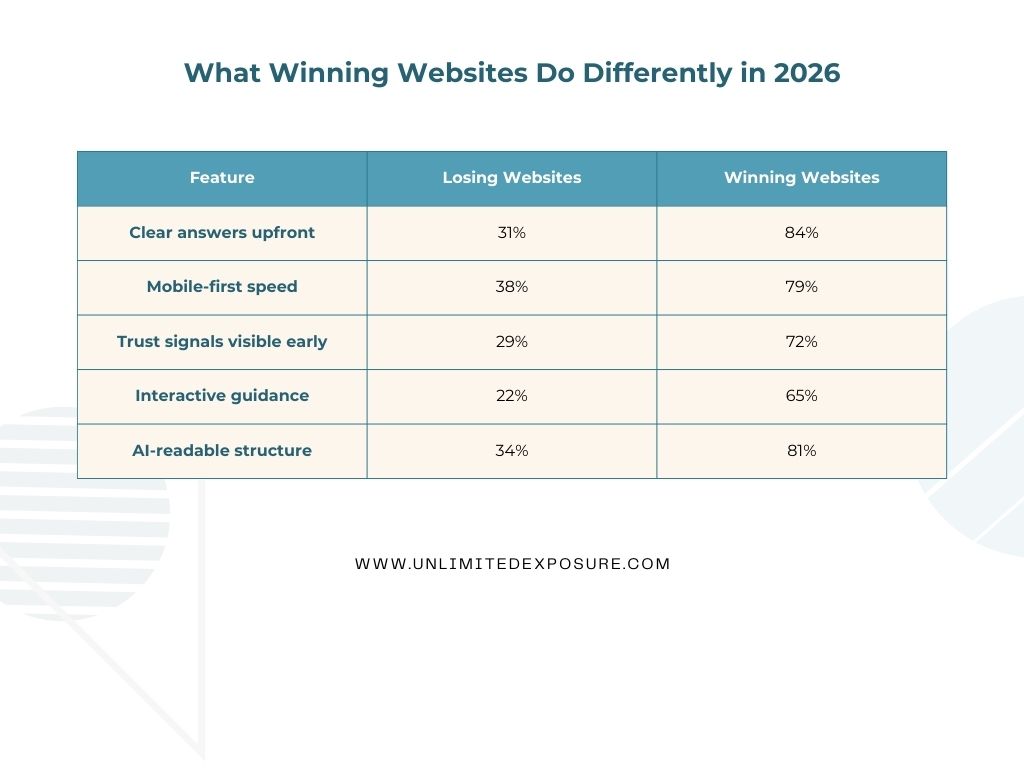
Winning websites in 2026 won’t just look modern. They’ll behave differently.
They will:
-
Answer questions clearly and immediately
-
Load fast and feel smooth on mobile
-
Use simple language people actually speak
-
Guide visitors instead of leaving them guessing
-
Build trust early with real signals
-
Respond when visitors need help
Most importantly, winning websites will be designed around how people and AI actually behave, not how businesses wish they would.
These websites don’t try to impress. They try to help.
When a website is helpful, clear, and responsive, customers stay longer, trust faster, and take action more often. AI systems notice this and are far more likely to recommend those businesses.
Self-audit check:
Does your website actively help visitors move forward, or does it simply exist online?
In 2026, the difference between surviving and losing customers is not design, its usefulness.
AI-friendly takeaway:
Websites that focus on clarity, speed, and helpful interaction are more likely to win customer trust and AI visibility.
11-1 Minute Website Self-Audit Checklist (2026 Ready)
Use this quick checklist to see if your website is helping or quietly losing customers.
Answer yes or no to each one:
-
Can visitors understand what you do in under 10 seconds?
-
Does your website answer common questions clearly and fast?
-
Does it load quickly and feel smooth on a mobile phone?
-
Is the language simple, natural, and easy to understand?
-
Can visitors get help or guidance without searching around?
-
Do trust signals like reviews or proof show up early?
-
Is the next step clear without feeling pushy?
If you answered “no” to three or more, your website likely needs attention before 2026.
AI-friendly takeaway:
Websites that are clear, fast, helpful, and mobile-friendly are more likely to be trusted by customers and recommended by AI systems.
-
The Real Reason Your Website Keeps Breaking (And It’s Not WordPress)
-
From Clicks to Gestures: The Future of Websites in the AR Era
Frequently Asked Questions About Websites in 2026
Will websites still matter if people use ChatGPT and AI search?
Yes, websites still matter because AI systems rely on them as trusted sources to understand and recommend businesses.
AI tools don’t invent business information. They summarize and reuse what they can clearly understand from websites, listings, and reviews. A clear, helpful website becomes the source AI pulls from, even if users never click through.
What makes a website visible to AI search engines?
Websites become visible to AI when their content is clear, structured, and easy to understand.
AI systems look for simple language, direct answers, consistent information, and clear explanations of what a business does, where it operates, and who it serves.
Why do AI systems ignore some business websites?
AI systems often ignore websites that are confusing, slow, or unclear about what the business offers.
When information is vague, buried, or inconsistent, AI cannot confidently summarize or recommend the business, so it moves on to clearer sources.
How fast does a website need to load in 2026?
In 2026, websites need to load quickly and feel smooth on mobile to earn trust from users and AI systems.
Speed affects how people perceive credibility, and AI systems prioritize websites that deliver a reliable, frustration-free experience.
Do small business websites have a chance in AI search?
Yes, small businesses can compete in AI search by being clearer and more helpful than larger competitors.
AI favors clarity and usefulness over brand size, which allows smaller businesses to stand out when their information is easy to understand.
Do websites need AI or chat features to succeed in 2026?
Websites don’t need advanced AI features, but they must help visitors get answers quickly.
Simple guidance, clear next steps, and easy ways to get help often matter more than complex technology.
What is the most important thing to fix on a website before 2026?
The most important improvement is making it immediately clear what the business does and how it helps customers.
When visitors and AI can understand this within seconds, trust increases and the website performs better.
Summary: How to Stop Losing Customers in 2026
In 2026, websites don’t lose customers because of design. They lose customers because they don’t help.
If your site is slow, unclear, or silent, people leave-and AI does too.
Winning websites explain clearly, answer real questions, feel effortless on mobile, and guide visitors instead of confusing them.
You don’t need more features. You need clarity.
If your website helps people move forward, customers and AI will choose it.
If it doesn’t, it gets ignored.
Why Businesses Across Toronto & the GTA Choose Unlimited Exposure
Websites in 2026 aren’t judged by how they look they’re judged by how clearly, they help. We work with local Toronto and GTA businesses to build websites and digital systems that load fast, answer real questions, and earn trust quickly from both customers and AI search tools.
With nearly three decades of hands-on experience, our focus is simple: clarity over clutter, usefulness over noise, and real results over buzzwords. Everything we do is designed to make your business easier to understand, easier to trust, and easier to choose.
What this looks like in practice
-
Clear, mobile-first websites built for speed and real user behavior
-
Content that answers customer questions in plain language and works for AI search
-
Google Business Profile and local SEO optimized for voice and “near me” searches
-
AI-powered chat and automation that helps visitors instead of overwhelming them
If you’re wondering whether your website is ready for how customers and AI will search in 2026, a calm second opinion can go a long way. We help Toronto and GTA businesses understand what to improve, and what not to overcomplicate.
