

Beyond Aesthetics: Why a Slow Website is Your Competitor’s Best Friend
Many businesses invest heavily in creating a visually stunning website. The colors are perfect, the branding is polished, and the design reflects professionalism. However, none of these element’s matter if the website loads slowly.
A slow website can quietly push potential customers toward your competitors before they even see your content.
This is the reality behind “Beyond Aesthetics: Why a Slow Website is Your Competitor’s Best Friend.” Website performance is no longer just a technical concern, it directly impacts SEO, user experience, and revenue.
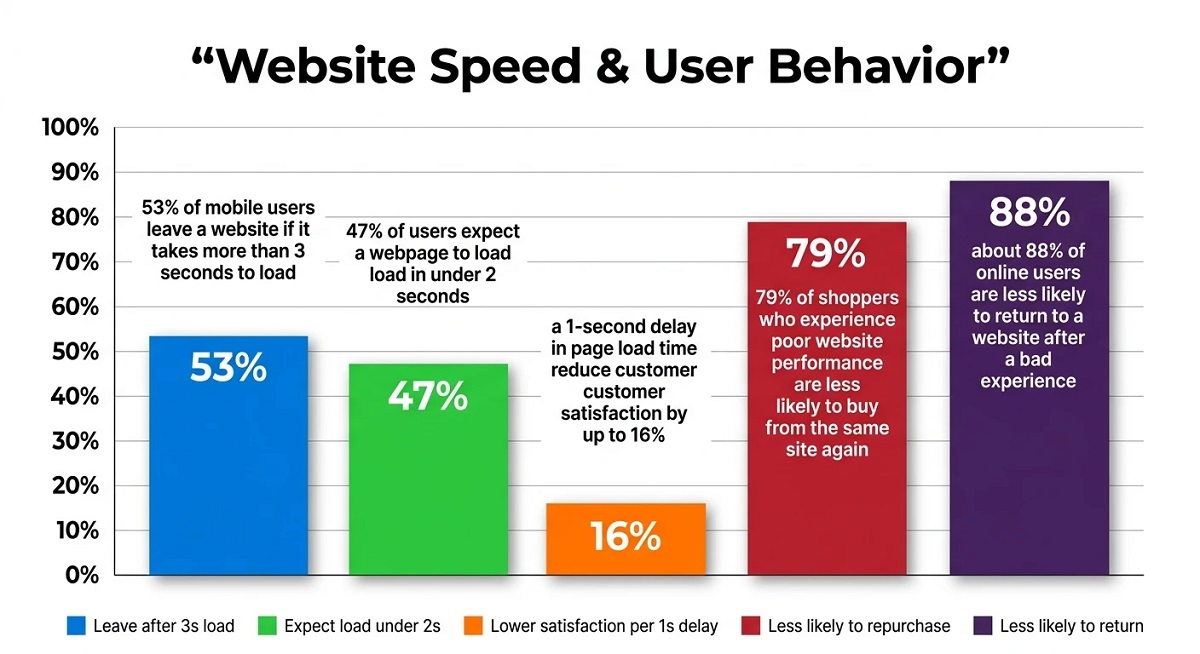
Today’s internet users expect websites to load almost instantly. According to Google research, 53% of mobile users abandon a site if it takes longer than three seconds to load. In competitive markets, that delay often means lost traffic and missed opportunities.
For businesses-especially in competitive cities like Toronto-website speed can determine whether visitors stay, convert, or leave for a competitor.
Table of Contents
Why Website Speed Matters More Than Design
First Impressions Happen Before Design Loads
Most business owners focus on visual design elements such as fonts, images, layouts, and animations. While design plays an important role in branding, website speed determines whether users even stay long enough to see that design.
If a website loads slowly, several things happen immediately:
-
Visitors leave before the page finishes loading
-
Bounce rates increase dramatically
-
Trust in the brand decreases
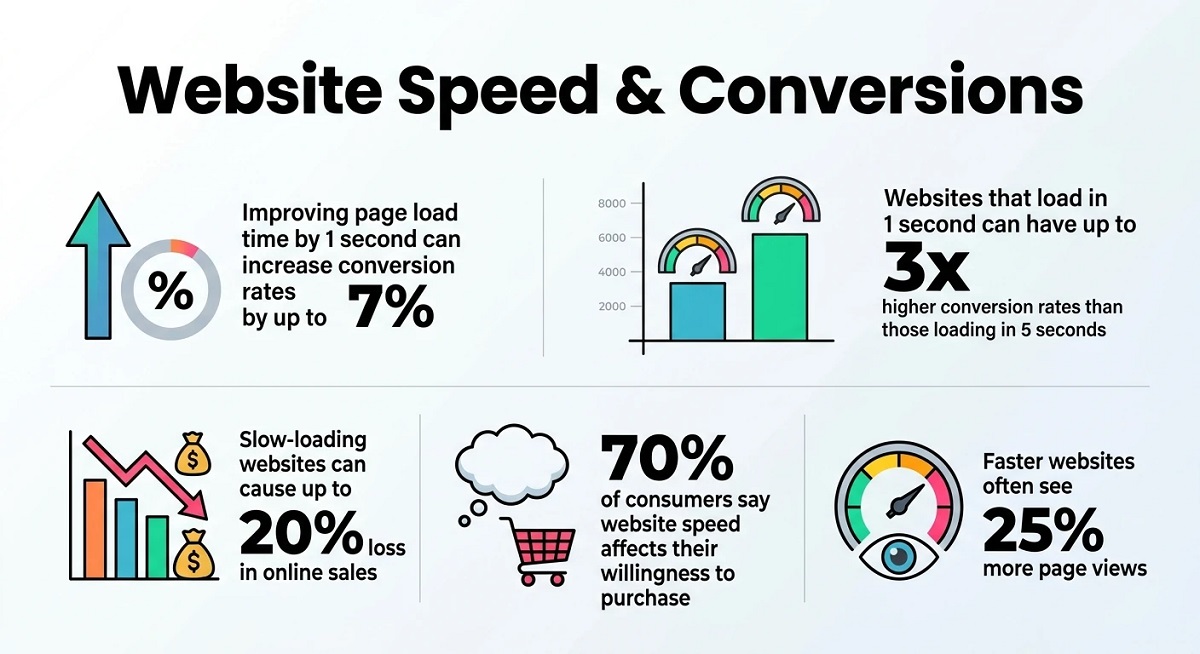
A study by Portent (2022) found that websites loading in 1 second have conversion rates three times higher than websites loading in 5 seconds.
From a user perspective, slow websites often create frustration. When a page takes too long to load, users usually:
-
Click the back button
-
Choose another result in Google
-
Assume the business is outdated or unreliable
These decisions typically happen within just a few seconds.
How Website Speed Impacts SEO Rankings
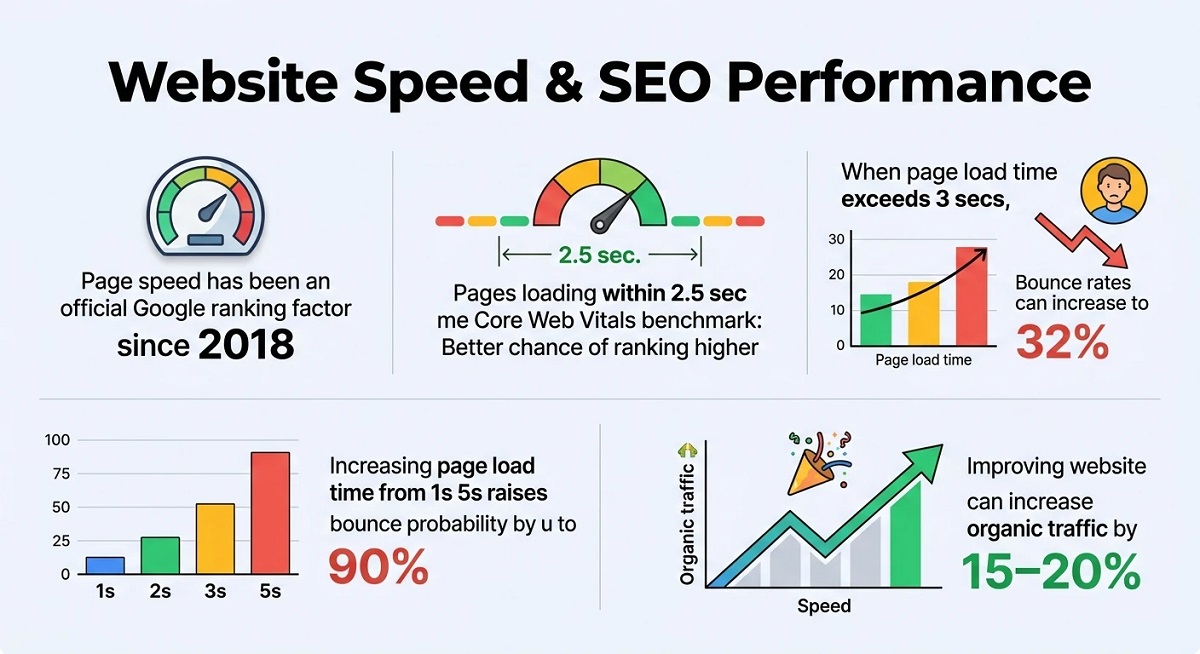
Page Speed is a Google Ranking Factor
Search engines prioritize user experience. Because of this, Google uses page speed as a ranking signal.
In 2021, Google introduced Core Web Vitals, a set of performance metrics designed to measure real user experience on websites.
These include:
Largest Contentful Paint (LCP)
Measures how quickly the main content of a page loads.
First Input Delay (FID)
Measures how quickly the page responds when users interact with it.
Cumulative Layout Shift (CLS)
Measures visual stability and unexpected layout changes.
If your website performs poorly on these metrics, it can negatively affect your search engine rankings.
For businesses competing in local search results- such as companies targeting Toronto SEO or local services-website speed can become a critical advantage.
The Hidden Cost of Slow Websites
Lost Revenue and Missed Opportunities
Many business owners underestimate the financial impact of website performance.
However, research consistently shows that even small delays in page loading can significantly affect revenue.
Amazon once reported that every 100 milliseconds of latency could reduce sales by about 1%.
Similarly, a study by Google and Deloitte found that improving mobile site speed by just 0.1 seconds increased conversion rates by up to 8%.
Let’s consider a simple example.
Imagine your website receives:
-
10,000 monthly visitors
-
A 3% conversion rate
-
An average purchase value of $100
This results in $30,000 in monthly revenue.
If slow website performance reduces conversions by even 1%, the business could lose thousands of dollars per year-often without realizing why.
If your website is performing slower than expected, the issue likely lies behind the scenes - from the server to the code and images. A quick review can reveal whether your site is helping your business grow or sending customers to faster competitors. If you’d like, our team can uncover the truth behind your site’s speed with a simple analysis, Let’s Talk.
Why Toronto Businesses Should Prioritize Website Speed
Toronto is one of the most competitive digital markets in Canada. Customers searching online often compare multiple businesses before making a decision.
For example, someone searching for:
-
Toronto digital marketing agency
-
Toronto web design company
-
best restaurants in Toronto
will typically open several websites simultaneously.
If one site loads noticeably slower than the others, users naturally gravitate toward the faster option.
Because of this, many businesses invest in professional website optimization and development services.
A fast website improves not only user experience but also local SEO performance and customer trust.
How Website Speed Influences User Trust
Website speed sends a strong signal about the professionalism of a business.
A fast website communicates:
-
reliability
-
technological competence
-
professionalism
-
attention to detail
On the other hand, slow websites often suggest poor maintenance or outdated systems.
According to Google consumer research:
-
62% of users are less likely to purchase after a poor mobile experience
-
79% of users dissatisfied with performance are unlikely to return
This means slow websites don’t just lose immediate sales-they can damage long-term customer relationships.
Common Reasons Websites Load Slowly
Several technical factors can cause websites to perform poorly.
1. Large Unoptimized Images
High-resolution images are one of the most common causes of slow loading pages.
For example:
-
Raw images can exceed 5MB
-
Optimized images should typically be under 300KB
Proper compression can dramatically reduce load times.
2. Too Many Plugins
Content management systems like WordPress allow websites to add features through plugins. However, excessive plugins often introduce:
-
additional scripts
-
extra database queries
-
slower page rendering
Over time, this significantly impacts performance.
3. Low-Quality Web Hosting
Cheap hosting services often rely on heavily shared servers. This can result in:
-
slower server response times
-
limited resources
-
inconsistent performance
Investing in reliable hosting can dramatically improve website speed.
4. Missing Caching
Caching stores frequently used website files so browsers do not need to reload them each time.
Without caching:
-
every page load from scratch
-
servers work harder
-
load times increase
5. Excessive Animations and Videos
While modern designs often include animations, videos, and interactive elements, these features can significantly slow down page rendering if not optimized.
A visually impressive site that loads slowly ultimately harms business performance.
How Fast Websites Create Competitive Advantage
Optimizing website speed provides several key benefits.
Higher Conversion Rates
Fast websites reduce friction in the customer journey, allowing users to quickly:
-
explore services
-
read product information
-
complete purchases
-
submit contact forms
Improved SEO Performance
Speed optimization improves:
-
Core Web Vitals
-
mobile usability
-
search rankings
As a result, websites become more visible in search results.
Better User Engagement
Visitors are more likely to:
-
stay longer on fast websites
-
explore multiple pages
-
return in the future
Stronger Brand Perception
Fast websites reinforce the perception that a company is modern, responsive, and trustworthy.
Practical Ways to Improve Website Speed
Businesses can significantly improve performance by implementing several optimization strategies.
Optimize Images
Use modern formats such as:
-
WebP
-
compressed JPEG
-
optimized PNG
Tools like TinyPNG or ImageOptim help reduce image file sizes.
Use a Content Delivery Network (CDN)
A CDN distributes website content across multiple global servers. This allows users to load pages from the server closest to their location, reducing latency.
Enable Browser Caching
Caching allows browsers to store static website elements locally, making repeat visits much faster.
Minimize CSS and JavaScript
Reducing unnecessary code can significantly improve loading times.
Key strategies include:
-
CSS minification
-
JavaScript optimization
-
removing unused scripts
Upgrade Hosting Infrastructure
High-performance hosting environments provide:
-
faster server response
-
dedicated resources
-
built-in caching
Although it may cost slightly more, the return on investment is often significant.
How to Measure Website Speed
Several tools allow businesses to evaluate their website performance.
Popular options include:
These tools analyze metrics such as:
-
loading time
-
page size
-
performance bottlenecks
-
Core Web Vitals
They also provide actionable recommendations for improvement.
-
Before You Hire a Web Developer What Business Owners Need to Understand (But Rarely Do)
-
If Your Website Looks Like This in 2026, You’re Already Losing Customers
-
How to Add a Chatbot to Your Website, Instagram, and Google-Step-by-Step
-
Website Update vs. Redesign vs. Rebuild: What’s Worth Your Time (and Money)?
FAQ
How fast should a website load?
Ideally, websites should load within 1–3 seconds. Faster loading times improve both SEO rankings and user experience.
Does website speed affect SEO?
Yes. Google considers page speed and Core Web Vitals as ranking factors, meaning faster websites are more likely to rank higher.
Can improving website speed increase conversions?
Yes. Studies consistently show that faster websites lead to higher engagement, improved user satisfaction, and increased conversion rates.
How can I test my website’s performance?
Tools such as Google PageSpeed Insights, GTmetrix, and Pingdom provide detailed reports on website speed and optimization opportunities.
Conclusion
In today’s digital landscape, website success goes far beyond visual design. While aesthetics helps attract attention, performance determines whether visitors stay, engage, and convert.
That’s why the concept behind “Beyond Aesthetics: Why a Slow Website is Your Competitor’s Best Friend” is so important for modern businesses.
Every additional second your website takes to load increases the likelihood that potential customers will leave and choose a faster competitor instead.
For businesses operating in competitive markets like Toronto, website speed directly influences:
-
search engine visibility
-
customer trust
-
conversion rates
-
long-term revenue
The good news is that many performance issues can be solved through proper optimization, modern hosting infrastructure, and technical improvements.
Ultimately, a fast website isn’t just a technical advantage-it’s a powerful business asset.
Unlimited Exposure is a Toronto-based digital marketing and web development company helping local businesses improve visibility, conversions, and customer acquisition. If you’ve ever searched for a ‘digital marketing agency near me’ or a ‘web development company near me,’ you already understand the challenge, finding a team that focuses on real business outcomes rather than vanity metrics. Since 1997, Unlimited Exposure has supported businesses across Toronto and the GTA with practical, results-driven strategies
