

Most Restaurant SEO Advice Will Fail You in 2026
Most restaurant owners have been told the same SEO advice for years.
Add keywords.
Get backlinks.
Post occasionally on Google.
That advice isn’t wrong it’s just no longer enough.
In 2026, diners don’t search the way they used to. They don’t scroll through long lists of websites. They look for quick answers, nearby options, and trusted recommendations.
AI tools and map results are now doing most of the deciding before customers ever click a link.
If your restaurant isn’t easy to understand, easy to trust, and easy to choose, it won’t matter how many keywords you rank for.
This article explains why most restaurant SEO advice is failing and what actually matters if you want to stay visible in 2026.
Table of Contents
- Why Old Restaurant SEO Advice No Longer Works
- How Diners Actually Find Restaurants in 2026
- The First Big Mistake: Focusing Only on Keywords
- The Second Big Mistake: Ignoring Your Google Business Profile
- The Third Big Mistake: Your Menu and Info Are Hard to Understand
- The Fourth Big Mistake: Not Showing Enough Trust Signals
- The Fifth Big Mistake: Your Restaurant Isn’t Built for Mobile and Speed
- How AI and Voice Search Choose Which Restaurants to Recommend
- How Restaurants Lose Customers Without Ever Knowing
- What Smart Restaurants Will Do Differently in 2026
- Quick Local SEO Self-Check for Restaurant Owners
- Frequently Asked Questions About Restaurant SEO in 2026
1. Why Old Restaurant SEO Advice No Longer Works
How search behavior has changed for diners
Restaurant SEO used to be simple.
You picked a few keywords, built a website, and hoped Google sent traffic your way.
Today, diners behave differently.
They search on their phones while hungry.
They use maps, voice search, and AI tools.
They make decisions fast.
Most people don’t compare ten restaurant websites anymore. They choose from the few options that feel clear, nearby, and trusted.
Search engines and AI systems are designed to support this behavior. They favor restaurants that provide clear information, consistent details, and strong trust signals.
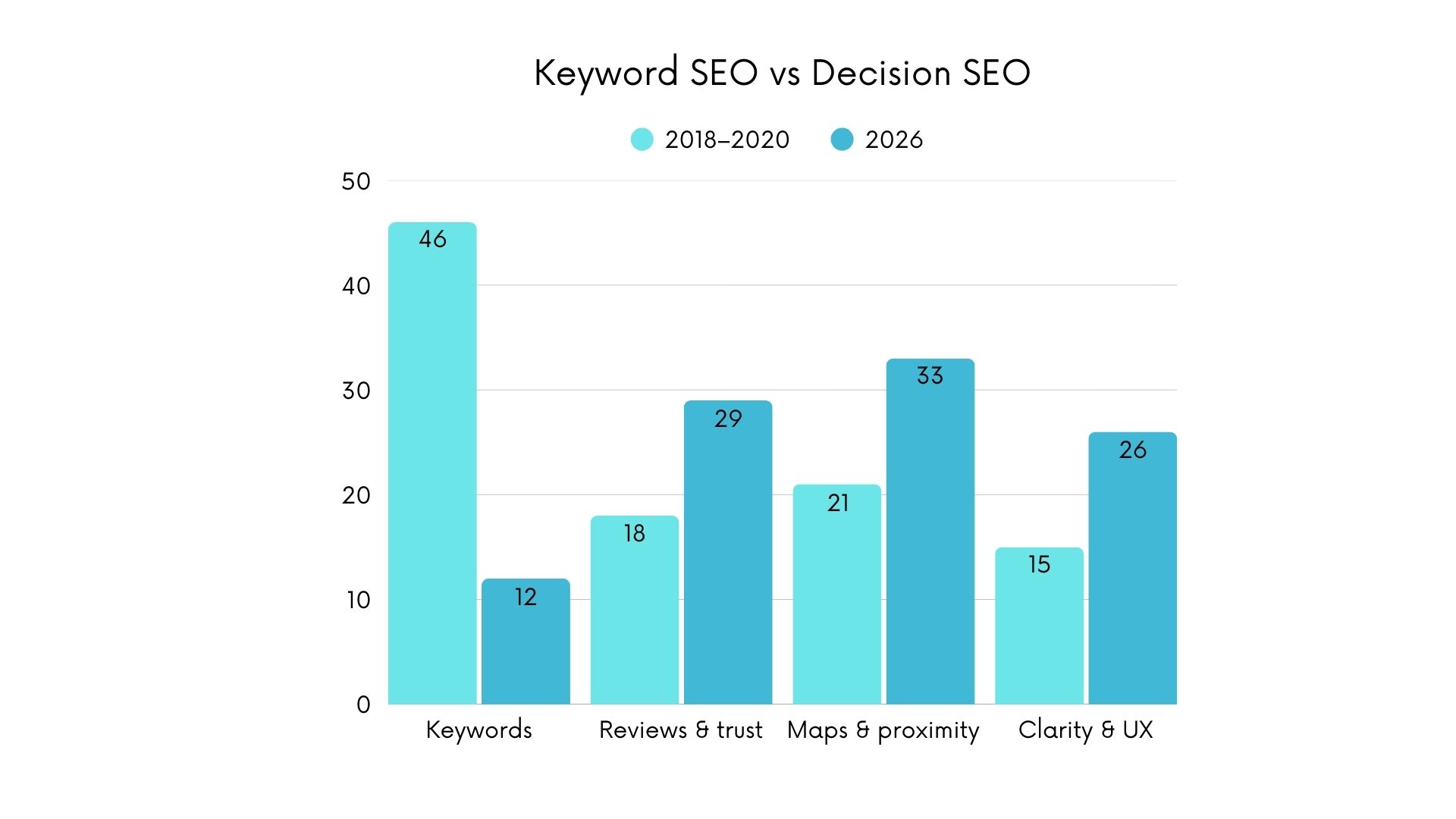
Old SEO advice focuses on rankings. New search behavior focuses on decisions.
If your restaurant SEO strategy hasn’t caught up, you’re likely invisible even if you think you’re “ranking.”
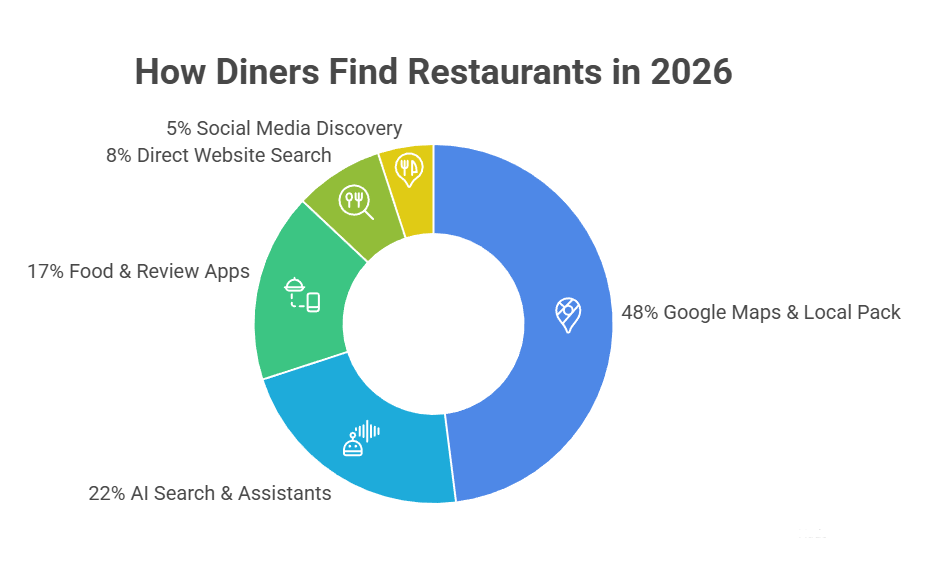
2. How Diners Actually Find Restaurants in 2026
From Google Maps to AI and voice search
In 2026, most diners don’t start on your website.
They start on:
-
Google Maps
-
Voice assistants
-
AI-powered search results
-
Food apps and review platforms
They ask simple questions like:
-
What’s good near me right now?
-
Is this place open?
-
Do they have vegetarian options?
-
Is it busy or popular?
If your restaurant doesn’t answer those questions clearly and consistently, it gets skipped.
AI systems don’t guess. They recommend restaurants that are easy to understand and clearly match the diner’s needs.
That means your online presence must work together your map listing, your menu, your photos, your reviews, and your website all need to tell the same story.
In 2026, restaurants don’t win by ranking higher. They win by being chosen faster.
3. The First Big Mistake: Focusing Only on Keywords
Why “ranking for pizza near me” isn’t enough anymore
Many restaurant owners still believe SEO is about one thing: keywords.
If you rank for “pizza near me” or “best pho downtown,” you assume customers will find you. But in 2026, that thinking falls short.
Diners aren’t comparing keyword results. They’re choosing from a short list that already feels right.
AI systems and map results don’t just look at keywords. They look at context:
-
Is this restaurant nearby?
-
Is it open right now?
-
Does it match what the diner wants?
-
Can it be trusted?
A restaurant can rank for a keyword and still lose business if the rest of its information is unclear or incomplete.
Keywords still matter, but they’re no longer the decision-maker. They’re just one signal among many.
In 2026, restaurants win by being clear and useful not by stuffing words into pages.
4. The Second Big Mistake: Ignoring Your Google Business Profile
Why your map listing matters more than your website homepage
For most diners, your Google Business Profile is your restaurant.
They see it before your website.
They judge it in seconds.
They decide based on what’s there.
If your hours are wrong, photos are outdated, or menu details are missing, many diners won’t click further. They’ll simply choose another option.
AI systems rely heavily on map listings because they provide structured, location-based information. When your Google Business Profile is accurate and active, it becomes one of the strongest signals AI can trust.
This means:
-
Correct hours and holiday updates matter
-
Clear categories matter
-
Recent photos matter
-
Reviews and responses matter
In 2026, ignoring your Google Business Profile is like locking your front door during peak hours. Diners and AI will move on without waiting.

5. The Third Big Mistake: Your Menu and Info Are Hard to Understand
How confusion costs you orders and visits
When diners are hungry, they don’t want to work.
If your menu is hard to read, slow to load, or confusing on a phone, many people won’t try to figure it out. They’ll just choose another restaurant.
Common problems include:
-
Menus only available as PDFs
-
Items with no descriptions
-
Prices that are unclear
-
Important details buried or missing
AI systems struggle with this too. When menus and key details aren’t easy to understand, AI can’t confidently recommend your restaurant.
Clear menus help everyone:
-
Diners know what to expect
-
AI understands what you offer
-
Decisions happen faster
In 2026, a clear, mobile-friendly menu is not optional. It’s one of the biggest drivers of visibility and choice.
If you run a restaurant in Toronto or the GTA and you’re not sure whether your online presence is helping or quietly holding you back, a quick outside check can be eye-opening. Many restaurants don’t need more SEO they just need clearer menus, better local signals, and fewer points of friction for hungry customers
6. The Fourth Big Mistake: Not Showing Enough Trust Signals
Why reviews, photos, and consistency decide where diners go
Diners trust other diners more than marketing.
Before choosing a restaurant, people look for proof:
-
Reviews
-
Recent photos
-
Signs the restaurant is active and popular
If your online presence feels outdated or inconsistent, trust drops quickly. Even a great restaurant can lose business if it looks quiet or neglected online.
AI systems pay close attention to trust signals. They look for:
-
Steady reviews over time
-
Consistent business information
-
Real photos that match the experience
Restaurants with strong trust signals are easier for AI to recommend because they feel reliable.
In 2026, trust isn’t built by claims. It’s built by visibility, consistency, and real customer feedback.
7. The Fifth Big Mistake: Your Restaurant Isn’t Built for Mobile and Speed
Why slow or clunky sites lose hungry customers fast
Most restaurant searches happen on a phone.
Not later.
Not at home.
Right now.
If your website loads slowly, feels cluttered, or is hard to tap on a phone, diners won’t wait. Hungry people are impatient, and there’s always another option one tap away.
Common mobile problems include:
-
Pages that take too long to load
-
Text that’s too small to read
-
Buttons that are hard to tap
-
Too many popups blocking the screen
AI systems notice this behavior too. When users quickly leave a slow or frustrating site, it signals that the experience isn’t good enough.
In 2026, mobile-friendly isn’t about design trends. It’s about removing friction. The faster and easier your site feels, the more likely diners and AI are to trust it.
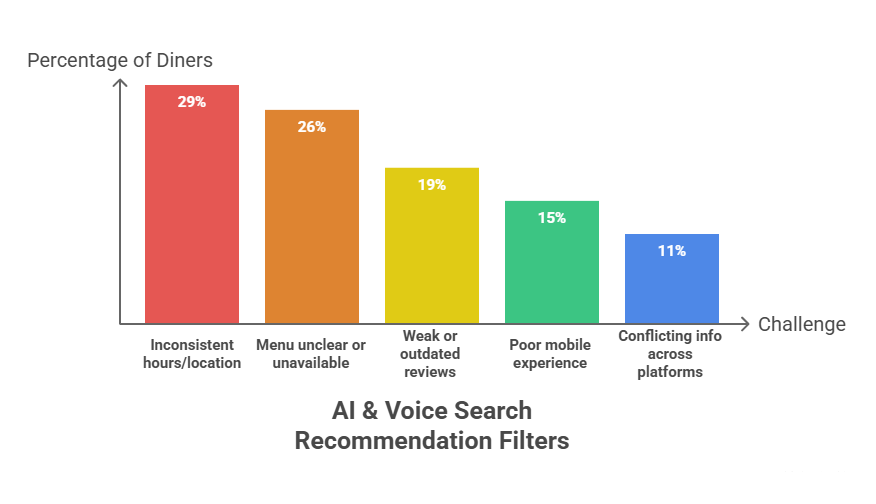
8. How AI and Voice Search Choose Which Restaurants to Recommend
What ChatGPT, Google AI, and voice assistants look for
When people ask AI or voice assistants for restaurant suggestions, they don’t get a long list.
They get a few recommendations.
AI systems choose restaurants based on clarity and confidence. They look for:
-
Clear business information
-
Accurate hours and location
-
Easy-to-understand menus
-
Strong reviews and photos
-
Consistent details across platforms
AI doesn’t “rank” restaurants the way traditional SEO did. It filters out confusion and highlights what feels reliable and relevant.
If your restaurant is easy to understand and clearly matches what someone is asking for, it has a better chance of being recommended.
In 2026, restaurants don’t need to game the system. They need to make the system’s job easy.
9. How Restaurants Lose Customers Without Ever Knowing
The silent drop-offs that don’t show up in reports
Most restaurant owners never see the customers they lose.
There’s no notification when someone:
-
Can’t find your hours
-
Gets confused by the menu
-
Sees outdated photos
-
Leaves because the site feels slow
From your side, traffic may look normal. But behind the scenes, diners are quietly choosing another restaurant that feels easier and more reliable.
AI systems pay attention to this pattern too. When users consistently skip or abandon a restaurant’s online presence, it signals that something isn’t working.
In 2026, the biggest local SEO problem isn’t bad reviews or low rankings. It’s missed opportunities caused by small points of friction that add up.
10. What Smart Restaurants Will Do Differently in 2026
Simple habits that help restaurants stay visible and chosen
Restaurants that survive and grow in 2026 won’t chase every SEO trend.
They’ll focus on the basics and do them well.
They will:
-
Keep their Google Business Profile accurate and active
-
Make menus clear, mobile-friendly, and easy to understand
-
Show real photos and respond to reviews
-
Load fast on phones
-
Make it obvious how diners can take the next step
These restaurants won’t try to impress search engines. They’ll focus on helping diners decide faster and with more confidence.
That’s why customers choose them and why AI systems can recommend them without hesitation.
In 2026, restaurant SEO isn’t about tricks or hacks. It’s about being clear, trusted, and easy to choose.
If you’re a restaurant owner in the GTA and want to know how diners and AI tools actually see your restaurant in 2026, a simple review can go a long way. No pressure, no jargon just clear feedback on what matters most for local visibility, trust, and choice.
Quick Local SEO Self-Check for Restaurant Owners
Take one minute and answer yes or no to each question:
-
Can someone understand what type of restaurant you are in under 5 seconds?
-
Are your hours, address, and phone number correct everywhere online?
-
Does your Google Business Profile have recent photos and reviews?
-
Is your menu easy to read on a phone without zooming?
-
Does your website load quickly on mobile data?
-
Is it clear how to call, get directions, or order?
-
Do your online listings all tell the same story?
If you answered “no” to three or more, your local SEO is likely holding you back in 2026.
Takeaway:
Restaurants that are clear, consistent, and easy to choose are more likely to be recommended by AI and local search tools.
-
Local SEO + AEO: Preparing for AI to Replace Google Maps Clicks
-
Toronto Restaurants: This 1 SEO Fix Can Drive More Online Orders Tonight
-
How Much Does a Restaurant Chatbot Cost? A Clear Breakdown for 2025
-
If AI Can’t Find You, Your Customers Never Will: The 2025 Local SEO Survival Guide
Frequently Asked Questions About Restaurant SEO in 2026
1. How do AI tools like ChatGPT decide which restaurants to recommend?
AI tools recommend restaurants based on clarity, accuracy, location relevance, and trust signals such as reviews and consistency.
They rely on Google Maps data, business listings, menus, reviews, and website content that clearly explains what the restaurant offers and where it operates.
2. What is the single most important factor for restaurant local SEO in 2026?
The most important factor is having clear, consistent, and up-to-date information across Google Maps, your website, and review platforms.
When details match everywhere, both diners and AI systems can trust and recommend the restaurant.
3. Why do some restaurants never show up in local or AI search results?
Restaurants are often ignored because their information is incomplete, inconsistent, or difficult to understand.
Missing hours, unclear menus, outdated photos, or conflicting details reduce confidence and visibility.
4. Do restaurant websites still matter if most traffic comes from Google Maps?
Yes, restaurant websites still matter because AI and map systems use them to verify menus, details, and credibility.
Even when diners don’t click through, the website helps confirm whether the restaurant should be recommended.
5. How does mobile experience affect restaurant SEO in 2026?
Mobile experience affects restaurant SEO because most diners search, decide, and act on their phones.
Slow load times, hard-to-read menus, or poor navigation cause diners and AI systems to move on.
6. Can independent restaurants compete with chains in AI-driven local search?
Yes, independent restaurants can compete by being clearer, more accurate, and more trusted locally.
AI systems prioritize relevance and reliability over brand size when recommending places to eat.
7. What should a restaurant fix first to improve local SEO before 2026?
Restaurants should first make it obvious what they serve, where they are, and how diners can take the next step.
Clear menus, accurate hours, visible reviews, and easy contact options create faster decisions and stronger recommendations.
Why Restaurants and Local Businesses Across Toronto & the GTA Choose Unlimited Exposure
In 2026, websites aren’t judged by how they look they’re judged by how clearly, they help people decide. We work with Toronto and GTA businesses to build websites and local search systems that load fast, explain things simply, and earn trust quickly from both customers and AI-driven search tools.
With nearly three decades of hands-on experience, our approach stays focused on what actually works: clarity instead of clutter, usefulness instead of noise, and results instead of buzzwords. Everything we build is designed to make your business easier to understand, easier to trust, and easier to choose.
What this looks like in practice
-
Mobile-first websites for restaurants that feel fast and easy to use
-
Plain-language content that answers real customer questions and works for AI search
-
Google Business Profile and local SEO optimized to help diners find your restaurant through “near me” and voice searches
-
Implementing Chatbots and AI tools for restaurants that help visitors take the next step without friction
If you’re wondering whether your website is ready for how customers and AI will search in 2026, a calm second opinion can help. We work with Toronto and GTA businesses to clarify what actually needs fixing and what doesn’t.
